|
|
Archive for the ‘Management’ Category
Monday, May 26th, 2014
 In one of Uncle Bob’s recent blog posts on the Single Responsibility Principle he uses the example of using people and organization boundaries as an indication of possible good software boundaries: In one of Uncle Bob’s recent blog posts on the Single Responsibility Principle he uses the example of using people and organization boundaries as an indication of possible good software boundaries:
When you write a software module, you want to make sure that when changes are requested, those changes can only originate from a single person, or rather, a single tightly coupled group of people representing a single narrowly defined business function. You want to isolate your modules from the complexities of the organization as a whole, and design your systems such that each module is responsible (responds to) the needs of just that one business function.
This is something that often comes up when I teach people about service boundaries when it comes to SOA – organization boundaries are the most intuitive choice.
And, once up on a time, that intuition might have indeed held up.
Stepping back in time
In the age before computers, organizations had a very specific way of structuring themselves.
People who had to work closely together sat in close physical proximity to each other. Data that was required on an ongoing basis would be in file cabinets also physically co-located with the people using that data, and it would be structured in a way that was optimal for their specific purposes. All of this was due to the high cost of communicating with people farther away.
If you needed data from a different department, you had requisition it by filling out a special form, put it in your outbox, and then some guy from the mail room would pick it up, and physically schlep it to the right department, putting it in their inbox, and then someone there would get your data for you – putting it together with your original request, and then the mail guy would schlep it back. This inbox/outbox style of communication should ring a bell from the messaging patterns I talk about with NServiceBus.
As a result, different departments had to have very clearly delineated responsibilities with minimal overlap with each other. The organization just couldn’t function any other way.
And then a bunch of us geeks came along.
Enter the age of computers and networks
By introducing this technology, the cost of communication across large distances started falling – slowly at first, and then quite dramatically.
When anyone in an organization was able access data from anywhere in the blink of an eye, an interesting dynamic started to unfold. All of a sudden, the division of responsibility between departments wasn’t as critical as it was before. When an employee needed to do something, there wasn’t this “that isn’t our job, you need to go to so-and-so” reaction. Because things could be done instantly, that’s exactly what happened.
And then came the politics
By removing the cost of communication, it became possible for more power-hungry people in the organization to start making (or trying to make) decisions that they couldn’t have made before. The introduction of computers into an organization was heralded as a new way of doing business – that the old organizational boundaries were a relic that we should leave behind us.
And thus can the re-org (the first of many).
Responsibilities and people were shuffled around, managers vied for more power, and politics took its’ place as one of the driving forces in the company structure.
Nowadays, if you want a decision made in a company, there isn’t just one person who has the authority to sign off on it anymore. No, you need to have meetings – and more meetings, with people you never knew existed in the company, or why on earth they should have a say on how something is supposed to get done. But that is now our reality: endlessly partially overlapping responsibilities across the organization.
So, what of the Single Responsibility Principle
This just makes it that much harder to decide how to structure our software – there is no map with nice clean borders. We need to be able to see past the organizational dysfunction around us, possibly looking for how the company might have worked 100 years ago if everything was done by paper. While this might be possible in domains that have been around that long (like banking, shipping, etc) but even there, given the networked world we now live in, things that used to be done entirely within a single company are now spread across many different entities taking part in transnational value networks.
In short – it’s freakin’ hard.
But it’s still important.
Just don’t buy too deeply into the idea that by getting the responsibilities of your software right, that you will somehow reduce the impact that all of that business dysfunction has on you as a software developer. Part of the maturation process for a company is cleaning up its’ business processes in parallel to cleaning up its’ software processes.
The good news is that you’ll always have a job 🙂
Posted in Agile, Architecture, Autonomous Services, Management, Messaging, OO, SOA | 2 Comments »
Saturday, April 19th, 2014
 There has been some discussion online recently about the issue of estimates in software development, specifically under a meme called #NoEstimates. There has been some discussion online recently about the issue of estimates in software development, specifically under a meme called #NoEstimates.
This came up when I was in London for the DevWeek conference at the speaker dinner with Austin Bingham, Rob Smallshire, and Allen Holub and I wanted to share some of the ideas that came up, as well as some of my personal opinions on the matter.
Context matters
When you’re in an organization that is continuously developing and evolving a product, platform, or suite, your context is quite different than when you’re working on a project either for an external client or an internal one.
In short: product vs. project.
While in both contexts you’ll want frequent releases, the main difference is that a project is meant to achieve a certain state of “done-ness” in a bound period of time. A product is not ever meant to be “done” in that way. A successful product is one that continues to evolve over time, with that success (arguably) resulting in more resources being dedicated to its development.
If we were to zoom out our scope beyond that of the project, we’d probably see certain product-ish qualities at the level of a client’s entire IT environment – no state of “done-ness” and similar consequences of success.
Where estimates are needed
Whether you’re in a product development organization or the CIO of an enterprise, there are a certain number of features/projects (FP) that people in “the business” want done. Let’s assume that each FP has a certain amount of business value that its implementation would result in and that that value is known in advance.
Sidebar: Clearly, the business value of any feature or project can not be known with much certainty in advance of it being implemented. Still, for the purpose of keeping the analysis simple for now, let’s table this issue for a bit.
While you might think it’s reasonable to perform the work on these FPs in order of decreasing value, that is mistaking revenue for profit/return-on-investment (ROI).
In other words, we need to know roughly how much each of them costs to be able to calculate its predicted ROI (value – cost).
Only then can we decide in which order to do the work.
So, we need somebody technical to give an estimate.
High-level estimates
In this context, sometimes it’s enough to provide 3-4 buckets describing the amount of work – I like the approach of using shirt sizes: S, M, L, XL.
This can help the organization decide quickly to charter the development of the FPs with very high value and very low cost. These low hanging fruit are great for getting started, but when you’re done with them, then you have to decide between a bunch of FPs whose predicted ROI are all very close to each other.
Before doing that (!), it’s important that no projects with an XL size are fully chartered as is – no matter what the value.
When a technical person gives an XL estimate, that means “this is so big, I really have no idea how long it’ll take”. The variance can be huge here – in some cases, they might not even be certain if the request is doable without being given some time to do additional research first. And that is exactly why you need to carve out a certain chunk of time and resources for doing that research.
“But you don’t understand, Udi! We need this done ASAP.”
Believe me when I say that that ship has already sailed.
There’s a pretty good chance that before that extra-large FP is half-done, so much time will have gone by that business priorities will have shifted. Unfortunately, by that time so many resources will have been invested in it that nobody will have the guts (or political capital) to pull the plug on it. The best people will start leaving – sometimes to other FPs but, more often, the company as well. Even when these nightmarishly large missions are eventually done – they end up being something of a Pyrrhic victory.
So, what to do?
Well, beyond financing a certain amount of directed and scoped research and development to get a better handle on that beast, let me suggest this:
Enter the “Lean Startup”
If you haven’t heard about it yet, and regardless of whether you’re actually working at a startup (I’d say that it is even more important for large organization), you need to check out the Lean Startup.
While I won’t be able to do justice to it here, let me use this admittedly gross oversimplification:
You are mistaken about the predicted business value.
Really.
So what you need to do is to start applying the scientific method – a series of experiments in which you are looking for proof to validate your hypothesis about the predicted value, where the outcome of one experiment is used to formulate another hypothesis to be tested in the next experiment.
Let me say this differently – until you are as rigorous in evaluating the predicted value of a given initiative as you are in estimating its cost, with that rigor increasing with the size of the initiative, you have no business starting to work on it.
And this is what’s missing from most of the software development world.
Portfolio management
I don’t really care what you call it, but the portfolio of potential investments and the risk analysis around them needs to be handled properly.
Based on the language I’ve chosen, you can see parallels to the world of finance. Now, before your mind starts going to the news of all the shady crap that’s been going on in the world of finance, understand that there are both positive and negative outliers in every domain.
That being said, I won’t point you to books on finance (at least, not for starters).
I suggest reading Manage your project portfolio, by Johanna Rothman (one of my favorite people in the world). She also has a couple of blogs, and that can help you get started.
This has already gotten quite long, so I’ll skip a bit and talk about what you should do if you’re “just” a developer being asked to give an estimate.
How to give a good fine-grained estimate
Here’s the format to use:
This will take a team of N between T1 and T2 and I am P% confident in that range, with the following assumptions (1, 2, 3), and most importantly, that the team does not work on anything else during that period of time.
Let me repeat that important bit again:
Assuming the team does not work on anything else.
Most of the kinds of people who ask for estimates aren’t going to like that kind of answer. You may get some pushback, “don’t be clever – can this be done by the end of the year, or not?”. In other words, they’re asking you for a commitment – not an estimate. This is common with certain types of dysfunctional organizations – the project management people are only measured on adherence to schedule, not on whether the system solves the right problem. You, the developer, want to make sure you’re solving the right problem – you want to be Agile. But that’s not the point.
Let me repeat – Agile is not the point.
If the organization around you is dysfunctional, be smart – don’t try to be right. Solving the right business problem is the right thing to do, but often it’s not smart thing to do. If you don’t like having to deal with this kind of organizational politics, you had better find yourself a different organization – otherwise, you had better be smart.
How to receive good estimates
Assuming you’re a team lead, project manager, product owner, or something similar, here’s how to respond when someone gives you an estimate in the above format.
- If P is subjectively high enough and T2 is subjectively low enough, give them the green light.
-
If P isn’t high enough, or the range of T1 to T2 is too broad:
- If you have previously given them time to do research (RT), double the value of RT.
- Make sure they are only doing research during this time (no other development).
- The purpose of the research is to increase P, or decrease the range of T1-T2
- When receiving the new estimate, go back to the beginning.
To be clear, “research” does not mean navel-gazing. It can and often will involve writing a bunch of code as well as on figuring out what the requirements should have been in the first place.
“But Udi, won’t this end up wasting time that could be better used on actually building the system?”
No.
In reality, this will end up paying back all the time that should have been spent up-stream on portfolio management and requirements analysis activities.
Which brings me to…
Working software over comprehensive documentation
Sometimes, writing high-quality working software is the last thing you want to do.
Specifically, the earlier you are in the project, the less likely that you should be focusing on code.
Often, the most cost-effective thing to do is some rapid-prototyping like creating UI mock-ups to verify what the system should really do.
This really deserves a blog post of its own (with thanks to Geert for finding the link), but suffice it to say that this is a skill-set all its own that should exist in every software development organization.
On other word on small startups – I often hear from people who are doing their own startup that want to do DDD, CQRS, SOA, and a bunch of other three-letter-acronyms they picked up on various blogs and books, because this time it’s up to them; this time they’re going to do it right.
No, no, no – stop that. Go read the Lean Startup. Then do it. And if you’re extremely lucky, you will be so successful that in a couple of years you will be in the position to rewrite the system – the only difference is that now you’ll REALLY know what the system is supposed to be.
In closing
OK – so that’s well over 1500 words I’ve spilled on the topic.
While the hashtag #NoEstimates makes a great soundbite, estimates are an important part of the information that needs to flow around the organization to help quantify and mitigate risk. Too often there are various organizational dysfunctions tangled up in the same areas as estimates which, I suppose, could give the impression that the estimates are to blame.
While I wish I could tell you that all you need to do is find an organization that doesn’t have any of these dysfunctions and all will be well for you, unfortunately there aren’t any organizations without them. Just like all families are dysfunctional in one way or another, so too are organizations. This is simply because each of us human beings is somewhat dysfunctional.
Well functioning organizations are made up of highly aware individuals – people who have become able to see and mitigate some of their personal issues, and thus can be patient as the people around them similarly work through their issues. Together, these individuals continuously create and adapt their working processes and systems to compensate for the various dysfunctions in the group.
Under these iteratively growing conditions of mutual trust, various kinds of estimates are performed at different levels and times and are just a normal part of communication and decision-making.
Please, don’t throw out the baby with the bath-water.
Posted in Agile, Coaching, Development, General, Management, Projects, The Team | 14 Comments »
Friday, December 27th, 2013
 For much of the history of computers, programmers really only had one path to take – upward into management. For much of the history of computers, programmers really only had one path to take – upward into management.
While you could go from Junior Programmer to Senior Programmer, sooner or later you were faced with the choice of becoming a Team Lead or having your career stagnate.
The primary difficult with becoming a team lead is that the skills that made you an excellent Senior Programmer didn’t really carry over to leading a team.
On leading teams
Much ink has been spilled (and keyboards been pounded) on this topic, so I’ll just give the common solution that is proposed to this issue – having a parallel technical career track to the traditional management track.
After being a senior programmer, developers can grow into architects and upwards. IBM, for example, has the title “Fellow” reserved for this ultimate level.
An IBM Fellow is an appointed position at IBM made by IBM’s CEO. Typically only 4 to 9 IBM Fellows are appointed each year in May or June. It is the highest honor a scientist, engineer, or programmer at IBM can achieve. —Wikipedia
All that’s well and good, but I have a feeling that something is still missing.
Why does it have to be either/or?
What if we allowed, nay – encouraged, developers to try both types of roles as they advance in their career?
After your first year as a senior programmer, you are then assigned to be a mentor to a junior programmer. You don’t assign them work, but take responsibility for some of their professional development. During this time, you also start learning what it takes to be a good team lead and developing your soft skills – yourself being mentored by a more senior team lead (probably not a good idea for it to be the team lead on the project you’re working on). From there, you take on a team lead role on a small-ish project leading 2-3 other developers.
During your time as a team lead, architects in the company work with you to deepen your technical knowledge of larger system concerns – grooming you for your next role: an architect. Your experience as a team lead gives you new found appreciation for managing technical risk.
Later, as an architect with developed soft-skills, you are now much more capable of getting teams to adopt your ideas and to want to do “the right thing”, rather than just deliver the project any way they know how. Even as you develop your expertise in various technological areas, the organization has an eye on bringing you back to being a team lead, this time on a larger project.
In praise of the zigzag
I think this has actually been happening more than just a little in our industry, although I believe it usually happens as people move from one company to another.
Is it possible that the limitations of the structures in their previous companies contributed to their choice to move to another company? Well, I wouldn’t discount it.
I don’t think companies should pigeonhole developers – either you’re an X or a Y.
Human beings thrive on variety and occasionally stretching out of their comfort zone.
I believe this model optimizes for people’s personal growth and can be tuned quite easily.
I think this is also very much in alignment with the Software Craftsmanship movement and can make it easier for companies to develop and hold on to the talent they’ve been lucky enough to hire in the first place.
In closing
While I believe this model is workable for a lot of the software industry, both for consulting companies and internal development organization, it’s clearly not going to be applicable for small startups. That being said, if the startup is successful and starts growing, it might not be such a bad idea to lay the groundwork for the team early on.
I don’t claim that this is the “best model” out there, and I haven’t tried it myself (yet), but I do believe that it has potential and would love to (re)spark the conversation about processes and structure that has seemed to die down under the Agile maxim of “Individuals and interactions over processes and tools” (though I believe that Agile as a whole *has* gotten us pointed in a better direction than where the industry was before).
What are your thoughts?
Write a comment or, even better, write something on your blog and spread the word!
Posted in Agile, Architecture, Community, Development, General, Management, The Team | 9 Comments »
Sunday, August 4th, 2013
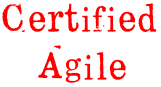 In this day and age where “Agile” is kind of the default in many organizations, I thought I’d point this out: In this day and age where “Agile” is kind of the default in many organizations, I thought I’d point this out:
I’m on record that every project needs its own methodology; further, that for most projects, the beginning, middle, and end are different enough to need their own; further, that every team ought to reexamine, alter and experiment every month.
Alistair Cockburn – one of the authors of the Agile Manifesto – 1, 2
Allow me to say that again:
Every project needs its own methodology
And that that methodology should not be statically adhered to – instead you should expect to adjust that methodology monthly, to the level that an external observer seeing the middle of your project would identify that you are, in fact, using a different methodology than the one you were using at the beginning of the project. And the same would go for the end of the project.
And if you don’t know Alistair yet, let me tell you – he really knows what he’s talking about.
Read more of Alistair’s work.
Posted in Development, General, Management, The Team | 4 Comments »
Thursday, September 27th, 2012
 We’ve all seen good ideas emerge in the software space – from objects, to components, to services, to domain models, and the *DD approaches. Yet, in most organizations, it is very hard for these ideas to get traction. We’ve all seen good ideas emerge in the software space – from objects, to components, to services, to domain models, and the *DD approaches. Yet, in most organizations, it is very hard for these ideas to get traction.
I’ve heard from countless developers and architects over the years about their frustration in getting everybody else to go along with them. “Can’t they see how much better [new approach] is over what we’re doing now?!” they ask, believing that things could and actually would be evaluated on their merits, especially in a rational field like IT.
The usual explanation I give has a couple of parts.
Conway’s Law
In 1968 Melvin Conway penned what later became known as Conway’s Law which stated:
“organizations which design systems … are constrained to produce designs which are copies of the communication structures of these organizations.”
An important corollary of that law is that if you wish to have a significant impact on the design of a system, you would need to have a similarly significant impact on the communication structure of the organization making that system.
The main problem is that the people that tend to be pushing for DDD, IoC, CQRS, SOA, etc are usually not as strong when it comes to the soft skills that are so necessary for bringing about organizational change. The thing is that, at a minimum, these types of changes take 3 to 5 years so it really takes a long-term commitment, both from the individual and the organization.
On the rationality of people in IT
First of all, people are a whole lot less rational than they’d like to believe – or that they’d like other people to notice. In fact, people will go to great lengths to maintain the appearance of consistency and rationality, even at the cost of harm to themselves. How’s that for irrational?
Don’t take my word for it – there’s a great book on the topic: Predictably Irrational: The Hidden Forces That Shape Our Decisions. The somewhat scary thing about it is that not only are we irrational beings, but that that irrationality can be predicted and, yes, even manipulated.
Once you can understand that the people you’re trying to convince aren’t Vulcan, you have a much better chance of being effective. I’d say that, for myself, understanding my own modes of irrationality increased my effectiveness as well, and made me quite a bit happier in life too.
Why you need to bring in a consultant
This isn’t me hawking my wares – believe me, I’m busy enough as it is, but let me know when this starts to sound familiar to you.
There’s a problem in your organization – could be that you’re not delivering software fast enough, high enough quality, whatever. Suffice it to say that Management isn’t happy. You’ve been living this pain for a while and know exactly what the source of the problem is (more often than not, management has at least a hand if not a whole arm in it). You come up with some recommendations, bring them to the higher-ups, but ultimately are ignored, dismissed, or don’t even get into the room.
Some time later, management brings in a Consultant (that’s right, with a capital ‘C’) who is there to figure out what’s wrong and come up with recommendations. In some cases, especially in larger organizations, they bring in a whole bunch of them from a brand name like McKinsey or Ernst & Young.
If these guys are smart, they listen to you, ultimately presenting your analysis and recommendations to management. Of course, those higher-ups are in awe of how quickly these guys were able to understand the inner workings of their organization. That awe lends instant credibility to their recommendations which are then adopted and given powerful political backing.
And you’re sitting there thinking, “but… but… but that’s what I was saying!!”.
It’s not the message – it’s the messenger.
Let me put it another way, explained from the perspective of management – we’re having problems, you work here, ergo you’re part of the problem. Also, you don’t make that much money (compared to management), so how smart could you be? Those brand-name consultants, well, they cost a LOT, so they MUST be good (good enough to know not to work here too).
Therefore the more the consultant costs, the more likely management is to listen, which ultimately creates the conditions for success, which makes the change happen, which proves to management that they were right to bring in an expensive consultant. A vicious (or virtuous) cycle – depending on how you look at it.
Now, it doesn’t always work this way, but it does often enough to perpetuate management’s world view.
In Closing
I do hope your organization and its leaders aren’t trapped in this kind of dysfunction, but if they are, know that you’re not alone and that you can get help – either via consulting or in some books:
Some good books include Made to Stick: Why Some Ideas Survive and Others Die and the grandfather of the field: How to Win Friends & Influence People. There are countless others and there isn’t any right place to start – the most important thing to do is to start.
It’s been over 40 years since Melvin Conway’s observation and, as an industry, we’re still relearning these things – usually through the school of hard knocks. But there is an upside here – I’m pretty sure that, knowing these patterns, you could pick up on some signals during the interviewing process and find a company that’s outgrown many of these issues – one that would be able to have more meritocratic discussions on technical choices.
In the worst case, you could become a consultant and make a living off of all this irrationality 🙂
Posted in Agile, Architecture, Coaching, Consulting, Development, General, Job Hunting, Life, Management, The Team | 7 Comments »
Sunday, January 8th, 2012
 Organizational change is hard – like the way a diamond is hard. Organizational change is hard – like the way a diamond is hard.
So, don’t try to change the organization. It’s too big anyway.
Instead, focus on changing one person at a time – that’s hard enough.
Don’t necessarily take the “one person as a time” too literally, though.
You don’t need to completely and utterly have one person won over before starting on the next.
Understand that for someone to change, that may require them admitting (either implicitly or explicitly) that the way they were doing things before was wrong. In some organizations, this can be suicide. Even if it isn’t, psychologically speaking, there are a huge number of barriers to overcome.
So, if at all possible, massage the situation in such a way that it’ll sound like they were right all along, and no-one really understood. It’s easy for someone to play along with the “misunderstood genius” story.
Next time – how to do just that.
Stay tuned.
Posted in Coaching, Consulting, Life, Management, The Team | 6 Comments »
Sunday, June 19th, 2011
 So it’s been about a year and a half since my promise to follow up on my Non-Functional Architectural Woes post. Just to give you a short summary, in that post I talked about the fact that many of today’s “best practices” for software design (like layering, ORMs, and web services) don’t actually provide the promised flexibility when requirements end up changing. So it’s been about a year and a half since my promise to follow up on my Non-Functional Architectural Woes post. Just to give you a short summary, in that post I talked about the fact that many of today’s “best practices” for software design (like layering, ORMs, and web services) don’t actually provide the promised flexibility when requirements end up changing.
Since that post I’ve blogged about many techniques and approaches to identify better boundaries (like with SOA and DDD) and I’m seeing more and more developers starting to apply them.
This post will be slightly different.
You see, occasionally we technical people will get requirements that can’t easily be broken down by functional boundaries. Sometimes the business calls this a “platform” – here’s an example:
“We want a flexible, customizable workflow-driven platform that allows end-users to add their own columns to any screen able to support massive datasets for large enterprise customers that will also be intuitive and easy to use for our SaaS push to small and medium-sized businesses (SMBs) – oh, and then it needs to be multi-tenant too. Did I mention that we promised this would be ready for our most important client by the end of the year?”
There is only one reasonable answer to the above:
“I know you want it but, I’m very sorry, you can’t have that. It isn’t possible to do that with one system.”
It’s really rare for a technical person to say something like that. The simple reason is that in software, we believe that almost everything is fundamentally possible – given enough time/money/resources. So, when someone in business comes to us with the requirements above, we say “It’s *possible*”, loosely translated to “We can’t prove that that’s impossible”.
There are many reasons why you can’t be SaaS and Enterprise at the same time – not all of them dealing with software. The marketing, sales, and support stories of each of those markets is VERY different. In the enterprise you’re usually working with professional services people that customize the generic product – which then becomes a backwards-compatibility requirement for new development. This will hinder the development team’s ability to roll out the new shiny features needed to remain competitive in the SaaS space.
In the cases where I’ve been brought in to help clients with these kinds of systems, I try to work my way up to the person in management who is in charge of the project/product – often the CEO. Then, in the nicest way possible, I explain that really the only way to have your cake and eat it too is to create 2 companies – each one focused on its own space – Saas and Enterprise; each one with its own development team, feature set, release schedule, etc.
There’s a reason that there’s an SAP *and* a Salesforce – it’s because no one can be all things to all people. It’s hard enough to become a market leader in just one space. Trying to do both is VERY expensive, and increases the chance of the project failing from the average 60-70% in the industry to probably about 99.9%.
Hope that will save you some grief.
Posted in Architecture, Development, General, Management | 5 Comments »
Saturday, June 5th, 2010
 In my work with clients the topic of how to handle the movement of software from one environment to another inevitably comes up. Sometimes this is in the context of NServiceBus but the problem is more generic. The faster that an organization is able to get software out the door, the more agile they can be. In my work with clients the topic of how to handle the movement of software from one environment to another inevitably comes up. Sometimes this is in the context of NServiceBus but the problem is more generic. The faster that an organization is able to get software out the door, the more agile they can be.
Unfortunately, there is one tiny little mistake that I see almost everywhere that gets in the way, and that’s going to be the topic of this post.
The Problem
Let’s say you have a standard web app environment – some web servers, application servers, and a database server. Your web servers need to send messages to the application servers. So far, so good.
In your test environment, you have an application server called AS_01_Test, and your web servers are configured to send it messages. However, in your staging environment the application server fulfilling that same role is called AS_01_Stage. This creates a configuration problem – you need to change the config of your web servers as you move the web app from Test to Staging.
I’ve seen companies doing all sorts of creative things to get around this problem – some of them involve putting all configuration settings in a database so that they can be centrally managed and visualized. I’d like to suggest an alternative approach.
What if…
What if server names were the same across all environments?
Well, you wouldn’t need to change configuration as you moved the system between environments. That’s a good thing.
But how can that be? Wouldn’t there be a conflict if there were two machines with the same name?
The answer is that there wouldn’t be a conflict if the machines were on different networks. Not all machines have to be on the same network. We can set up as many networks / virtual networks as we like. And it is clear that we don’t need machines in one environment / network to talk to machines in another environment. I mean, under no circumstances would we want web servers in our test environment to talk to application servers in the production environment.
These separate networks provide much needed isolation, beyond solving the server naming problem.
In closing
It’s really a tiny thing when you think about – multiple networks. But that’s exactly why software developers overlook it so often – because it’s not a “software solution” to the configuration problem we perceive as a “software problem”.
I wrote about related multi-environment configuration issues in this earlier post: Convention over Configuration – The Next Generation
I’m happy to say that this functionality is now in NServiceBus called “profiles” and you can read more about how they work here.
How are you handling the flow of moving software through to production? Leave your comments below.
Posted in Architecture, Development, Management, Simplicity | 9 Comments »
Friday, May 7th, 2010
 With the growing interest in Command/Query Responsibility Segregation (CQRS), more people are starting to ask questions about how to apply it to their applications. CQRS is actually in danger of reaching “best practice” status at which point in time people will apply it indiscriminately with truly terrible results. With the growing interest in Command/Query Responsibility Segregation (CQRS), more people are starting to ask questions about how to apply it to their applications. CQRS is actually in danger of reaching “best practice” status at which point in time people will apply it indiscriminately with truly terrible results.
One of the things that I’ve been trying to do with my presentations around the world on CQRS was to explain the why behind it, just as much as the what. The problem with the format of these presentations is that they’re designed to communicate a fairly closed message: here’s the problem, here’s how that problem manifests itself, here’s a solution.
In this post, I’m going to try to go deeper.
The hitchhiker’s guide to the galaxy
In this most excellent book, one of the things that struck me was the theme that made it’s way through the whole book – starting with the answer to life, the universe, and everything: 42. By the time you get to the end of the book, you find out that the real question to life, the universe, and everything is “what do you get when you multiply 6 by 9”. And that’s how the book leaves it.
To us engineers, we can’t just accept the fact that the book would say that 6*9 = 42 when we know it’s 54. After bashing our heads on the rigid rules of math, we realize that not all math problems are necessarily in base 10, and that if we switch to base 13, the number 42 is 4*13 + 2 = 54. So, the book was right – but that’s not the point.
What’s the point?
The hitchhiker’s guide is an example of a teaching technique which presents an apparent paradox, leaving the student to dig up unspoken and unthought assumptions in order to resolve it. Key to this technique are rigid rules which do not allow any compromise or shortcuts on the student’s part.
The purpose of this technique is not for the student to learn the answer, but to gain deeper understanding, which in turn changes the way they go about thinking about problems in the future.
So, when given the problem 4*5, we do not just immediately answer 20, instead we clarify in which numeric base the question is being phrased, and only then go to solve the problem. In base 13, the answer would be 17. In hex, the answer would be 14.
The externally visible change is that we know which questions to ask in order to arrive at the right answer – not that we know the answer ahead of time.
Making an “ass” out of “u” and “me”
Let’s start at the end – one of the unspoken assumptions that has been causing problems:
All businesses can be treated the same from the perspective of software.
In our previous example, we assumed that all math problems use base 10. It turns out that different bases are useful for different domains (like base 2 for computers). We can say similar things about degrees and radians in geometry. The more we look at the real world, the more we see this repeating itself. There’s no reason that software should be any different.
Base 10 is not a ubiquitous best practice. We shouldn’t be surprised that there really aren’t best practices for software either.
Here’s another problematic assumption:
“The business” can (and do) tell us what they need in a way we can understand.
So many software fads have been built on the quicksand of this assumption. OOAD – on verbs and nouns. 4GL and other visual tools that “the business” will use directly. SOA – on IT business alignment. I expect we haven’t seen the end of this.
Some of you may be wondering why this is false, others are sagely nodding their heads in agreement.
The myth of “the business”
Unless you have a single user, who is also the CEO paying for the development, there is no “the”. It’s an amalgam of people with different backgrounds, skills, and goals – there is no homogeneity. Even if no software was involved, many business organizations are dysfunctional with conflicting goals, policies, and politics.
To some extent, we technical people have hidden ourselves away in IT to avoid the scary world of business whose rules we don’t understand. With the rise in importance of information to the world, we’ve been pulled back – being forced to talk to people, and not just computers. Luckily, we’ve been able to create a buffer to insulate ourselves – we’ve taken the less successful technical people from our heard and nominated them “business analysts”. No, not all companies do it this way, but we do need to take a minute to reflect on how information flows between the business Mars into and out of the IT Venus.
On human communication
Even if we made this insulation layer more permeable, allowing and encouraging more technical people and business people to cross its boundary, we still need to deal with the problem of two humans communicating with each other. There are enough books that have been written on this topic, so I won’t go into that beyond recommending (strongly) to technical people to read (some of) them.
Rather, I’d like to focus on the environment in which these discussions take place. IT has been around long enough, and users have used computers long enough, that a certain amount of tainting has taken place. If the world was a trial, the evidence would have been thrown out as untrustworthy.
When users tell you what they want, they’re usually framing that with respect to the current system that they’re using. “Like the old system – but faster, and with better search, and more information on that screen, and…”
At this point, business analysts write down and formalize these “requirements” into some IT-sanctioned structure (use cases, user stories, whatever), at which point developers are told to build it. Users only know what they didn’t want when developers deliver exactly what was asked.
How can that be?
These are not the “requirements” you are looking for
Users ultimately dictate solutions to us, as a delta from the previous set of solutions we’ve delivered them. That’s just human psychology – writer’s block when looking at a blank page, as compared to the ease with which we provide “constructive criticism” on somebody else’s work.
We need to get the real requirements. We need to probe beyond the veneer:
- Why do you need this additional screen?
- What real-world trigger will cause you to open it?
- Is there more than one trigger?
- How are they different?
- etc, etc, etc…
This is real work – different work than programming. It requires different skills. And that’s not even getting into the political navigation between competing organizational forces.
But let’s say that you don’t have (enough) people with these skills in your organization. What then?
Enter CQRS
CQRS gives us a set of questions to ask, and some rigid rules that our answers must conform to. If our answers don’t fit, we need to go back to the drawing board and move things around and/or go back to “the business” and seek deeper understanding there.
For each screen/task/piece of data:
Will multiple users be collaborating on data related to this task?
Look at every shred of raw data, not just at the entity level.
Are there business consistency requirements around groups of raw data?
If “the business” answers no – ask them if they see that answer changing, and if so, in what time frame, and why. What changing conditions in the business environment would cause that to change – what other parts of the system would need to be re-examined under those conditions.
After understanding all that and you find a true single-user-only-thing, then you can use standard “CRUD” techniques and technologies. There are no inherent time-propagation problems in a single-user environment – so eventual consistency is beyond pointless, it actually makes matters worse.
On the other hand, if the business-data-space is collaborative, the inherent time-propagation of information between actors means they will be making decisions on data that isn’t up-to-the-millisecond-accurate anyway. This is physics, gravity – you can’t fight it (and win).
The rule for collaboration
Actors must be able submit one-way commands that will fail only under exceptional business circumstances.
The challenge we have is how to achieve the real business objectives uncovered in our previous “requirements excavation” activities and follow this rule at the same time. This will likely involve a different user-system interaction than those implemented in the past. UI design is part of the solution domain – it shouldn’t be dictated by the business (otherwise it’s like someone asking you to run a marathon, but also dictating how you do so, like by tying your shoelaces together).
Many of the technical patterns I described in my previous blog post describe the tools involved. BTW, hackers can be considered “exceptional actors” – the business actually wants their commands to fail.
In Summary
The hard and fast rule of CQRS about one-way commands is relevant for collaborative domains only. This domain has inherent eventual consistency – in the real world. Taking that and baking it into our solution domain is how we align with the business.
The process we go through, until ultimately arriving at one-way-almost-always-successful-commands is business analysis. Rejecting pre-formulated solutions, truly understanding the business drivers, and then representing those as directly as possible in our solution domain – that’s our job.
After doing this enough times and/or in more than one business domain, we may gain the insight that there is no cookie-cutter, one-size-fits-all, best-practice solution architecture for everything. Each problem domain is distinct and different – and we need to understand the details, because they should shape the resulting software structure.
The next time the business tell us to implement 42, we’ll use CQRS along with other questioning techniques until we can get “6 x 9” out of them, learning from the exercise what are the significant and stable parts of the business – ultimately helping us to “build the right system, and to build the system right”.
Don’t Panic 🙂
Posted in Architecture, CQRS, Development, Management, Simplicity | 24 Comments »
Saturday, May 1st, 2010
 It appears that my last post caught a lot of people’s attention, with responses online and offline from people in the community as well as inside Microsoft. Some read it as a criticism of Microsoft. Others found it rang true with their experiences, particularly in their interactions with technological decision makers. One thing I’d like to do in this post is to broaden the scope of the discussion to include the Java side as well, as many in the enterprise space are working in a multi-platform/multi-vendor environment. Let’s start with some history. It appears that my last post caught a lot of people’s attention, with responses online and offline from people in the community as well as inside Microsoft. Some read it as a criticism of Microsoft. Others found it rang true with their experiences, particularly in their interactions with technological decision makers. One thing I’d like to do in this post is to broaden the scope of the discussion to include the Java side as well, as many in the enterprise space are working in a multi-platform/multi-vendor environment. Let’s start with some history.
Java takes the enterprise
When Java originally came out, it was an interesting language that you could use to write applets – code that would run the same everywhere, in the browser, on the desktop, etc. SUN was the keeper of Java. And then came this concept of a container – the thing that would run your Java code, which then grew to handle things like transactions, and became the Enterprise Java Bean – EJB, and that came out of IBM, with SUN adopting it later.
The adoption of Java at that point was important enough that the specs were opened up, and many EJB technologies blossomed. With backing from big companies already inside the enterprise, the only possible fight came from COBOL around Y2K, but that was a dying gasp. Microsoft wasn’t in the game as Windows NT wasn’t competition for UNIX or mainframes.
Multi-vendor as a way of life
With multiple big and medium-sized vendors offering similar, competing, and complementary technologies, all tied together by the promise of backwards compatibility in Java and the specs demanding interoperability, customers could safely go for best-of-breed solutions. This forced technological decision makers to truly evaluate the offerings on merits, not just lineage.
Many attribute the rise of OSS in Java to the fact that the existing containers were so heavyweight. I believe that was a secondary effect. As a result of the fact that the industry had embraced and internalized the values of thinking and choosing for itself, it was willing to look at alternatives with much humbler lineage, ultimately using them on their merits. It was the culture.
The Microsoft ecosystem
This culture was practically nonexistent on the Microsoft side of the border. As the only vendor, Microsoft was put on a pedestal – it was the best, period. The industry hungrily looked to Seattle not only for technology, but also for guidance and leadership. If a developer could get a job at Microsoft, they were “hot stuff”, the best of the best. This isn’t a bad thing – it was just a thing.
This enabled technological decision makers on the Microsoft side to have much shorter thought and decision processes than their counterparts on the Java side.
All of these things got baked into the culture.
About Microsoft
Like all that were ever on a pedestal, the fall was a matter of time. Expectations being that high, it was inevitable. You can’t make all people happy all the time, and the conditions in the industry were changing, and the company had to change to remain competitive.
Let me say this clearly: Microsoft was not at fault.
Sure, it’s easy to say in retrospect they should have communicated more clearly about this, or built that technology differently. If you haven’t yet worked in a big company, you may not know this, but big companies aren’t just bigger small companies. It’s a hodge-podge of competing agenda, initiatives, politics, people, and power. There’s a saying that things only get done despite the organization’s best efforts.
For a company Microsoft’s size, what they manage to get done is incredible.
On acquisitions and OSS
Microsoft has come under fire over the years for offering their own implementations of open source technologies- as if the vendors on the Java side didn’t do this. The Java world was ultra competitive, the big vendors would eat promising upstarts in order to win back lost contracts to key customers. This made the technological decision makers broaden their thought processes to include risk management as a part of managing their technological portfolio. To a large extent, this actually justifies the existence of a C-level role related to technology – the CIO.
Chief Officers of Information and Technology
I found it interesting to see the difference in age, experience, background, and thought processes between people holding the CIO title at organizations that were Microsoft-centric and those with a more heterogeneous technology investment. This was likely influenced to a large extent by the history of technological evolution, age and size of organizations with the resulting culture and hiring practices, among other things. This pattern continued with the CTO as well.
Obviously one wouldn’t expect the same thought processes in the CTO of a 20 person IT shop and the CTO of Ford Motor Company (for example). They shouldn’t be the same.
It appeared that as Microsoft became more focused on innovation they started listening more to the technology leaders of smaller companies, not a bad thing by itself. Choosing A means not choosing B, and in order to stay competitive, a choice must be made.
Fast forward
I think that what happened was necessary, and will be good for the industry and Microsoft. Technological decision making in companies that were traditionally Microsoft-centric has evolved. This has clarified Microsoft’s role as a platform vendor who can be trusted, and whose tools can be used or not used as the situation dictates, with comparable commercial and OSS tooling evaluated on the same criteria.
Just as IBM reinvented itself and now occupies a sustainable role in a combined commercial and OSS ecosystem of platforms, tools, and services, Microsoft appears to have made several big strides partnering with the community in much more productive ways, yet with more strides to be made as well.
A challenge to OSS on the Microsoft platform
In this new and more mature environment, OSS can’t remain the same either. Some code a developer whipped up in their free time and put in an online accessible repository with a decent license just won’t cut it any more.
In my previous post I called out the Linq2Sql support story – the same goes for OSS. Active development is required, and so is support, and so is documentation. The commitment needs to be much more serious.
Also, until usage reaches some critical mass, it is unlikely that a single developer or even a small group of committers will be able to do it without the help of the community. Really the only alternative is for there to be some commercial story that can fund it – support, consulting, training, commercial add-ons, etc. A combination of community (both dev and use) and commercial cash-flow is probably most sustainable.
If you are running an OSS project, understand that these criteria will be used to evaluate it.
In closing
I think I’ve managed to alienate previous supporters from all sides.
I believe we are entering some interesting times, where not only are vendors and OSS projects being evaluated differently than in the past, but that traditional architectural paradigms are changing as well.
Regardless of what the answers are, I’m happy that more of us are asking more questions. Some questions are the right questions, some are the wrong ones, and sometimes we just ask at the wrong time, but as an industry I think that we’re getting better.
Thanks for reading.
Posted in Development, General, Management | 1 Comment »
|
|
|
Recommendations
Bryan Wheeler, Director Platform Development at msnbc.com
“ Udi Dahan is the real deal.We brought him on site to give our development staff the 5-day “Advanced Distributed System Design” training. The course profoundly changed our understanding and approach to SOA and distributed systems. Consider some of the evidence: 1. Months later, developers still make allusions to concepts learned in the course nearly every day 2. One of our developers went home and made her husband (a developer at another company) sign up for the course at a subsequent date/venue 3. Based on what we learned, we’ve made constant improvements to our architecture that have helped us to adapt to our ever changing business domain at scale and speed If you have the opportunity to receive the training, you will make a substantial paradigm shift. If I were to do the whole thing over again, I’d start the week by playing the clip from the Matrix where Morpheus offers Neo the choice between the red and blue pills. Once you make the intellectual leap, you’ll never look at distributed systems the same way. Beyond the training, we were able to spend some time with Udi discussing issues unique to our business domain. Because Udi is a rare combination of a big picture thinker and a low level doer, he can quickly hone in on various issues and quickly make good (if not startling) recommendations to help solve tough technical issues.” November 11, 2010
 Sam Gentile, Independent WCF & SOA Expert
“Udi, one of the great minds in this area. A man I respect immensely.”
 Ian Robinson, Principal Consultant at ThoughtWorks
"Your blog and articles have been enormously useful in shaping, testing and refining my own approach to delivering on SOA initiatives over the last few years. Over and against a certain 3-layer-application-architecture-blown-out-to- distributed-proportions school of SOA, your writing, steers a far more valuable course."
 Shy Cohen, Senior Program Manager at Microsoft
“Udi is a world renowned software architect and speaker. I met Udi at a conference that we were both speaking at, and immediately recognized his keen insight and razor-sharp intellect. Our shared passion for SOA and the advancement of its practice launched a discussion that lasted into the small hours of the night. It was evident through that discussion that Udi is one of the most knowledgeable people in the SOA space. It was also clear why – Udi does not settle for mediocrity, and seeks to fully understand (or define) the logic and principles behind things. Humble yet uncompromising, Udi is a pleasure to interact with.”
 Glenn Block, Senior Program Manager - WCF at Microsoft
“I have known Udi for many years having attended his workshops and having several personal interactions including working with him when we were building our Composite Application Guidance in patterns & practices. What impresses me about Udi is his deep insight into how to address business problems through sound architecture. Backed by many years of building mission critical real world distributed systems it is no wonder that Udi is the best at what he does. When customers have deep issues with their system design, I point them Udi's way.”
 Karl Wannenmacher, Senior Lead Expert at Frequentis AG
“I have been following Udi’s blog and podcasts since 2007. I’m convinced that he is one of the most knowledgeable and experienced people in the field of SOA, EDA and large scale systems.
Udi helped Frequentis to design a major subsystem of a large mission critical system with a nationwide deployment based on NServiceBus. It was impressive to see how he took the initial architecture and turned it upside down leading to a very flexible and scalable yet simple system without knowing the details of the business domain.
I highly recommend consulting with Udi when it comes to large scale mission critical systems in any domain.”
 Simon Segal, Independent Consultant
“Udi is one of the outstanding software development minds in the world today, his vast insights into Service Oriented Architectures and Smart Clients in particular are indeed a rare commodity. Udi is also an exceptional teacher and can help lead teams to fall into the pit of success. I would recommend Udi to anyone considering some Architecural guidance and support in their next project.”
 Ohad Israeli, Chief Architect at Hewlett-Packard, Indigo Division
“When you need a man to do the job Udi is your man! No matter if you are facing near deadline deadlock or at the early stages of your development, if you have a problem Udi is the one who will probably be able to solve it, with his large experience at the industry and his widely horizons of thinking , he is always full of just in place great architectural ideas.
I am honored to have Udi as a colleague and a friend (plus having his cell phone on my speed dial).”
 Ward Bell, VP Product Development at IdeaBlade
“Everyone will tell you how smart and knowledgable Udi is ... and they are oh-so-right. Let me add that Udi is a smart LISTENER. He's always calibrating what he has to offer with your needs and your experience ... looking for the fit. He has strongly held views ... and the ability to temper them with the nuances of the situation. I trust Udi to tell me what I need to hear, even if I don't want to hear it, ... in a way that I can hear it. That's a rare skill to go along with his command and intelligence.”
Eli Brin, Program Manager at RISCO Group
“We hired Udi as a SOA specialist for a large scale project. The development is outsourced to India. SOA is a buzzword used almost for anything today. We wanted to understand what SOA really is, and what is the meaning and practice to develop a SOA based system.
We identified Udi as the one that can put some sense and order in our minds. We started with a private customized SOA training for the entire team in Israel. After that I had several focused sessions regarding our architecture and design.
I will summarize it simply (as he is the software simplist): We are very happy to have Udi in our project. It has a great benefit. We feel good and assured with the knowledge and practice he brings. He doesn’t talk over our heads. We assimilated nServicebus as the ESB of the project. I highly recommend you to bring Udi into your project.”
 Catherine Hole, Senior Project Manager at the Norwegian Health Network
“My colleagues and I have spent five interesting days with Udi - diving into the many aspects of SOA. Udi has shown impressive abilities of understanding organizational challenges, and has brought the business perspective into our way of looking at services. He has an excellent understanding of the many layers from business at the top to the technical infrstructure at the bottom. He is a great listener, and manages to simplify challenges in a way that is understandable both for developers and CEOs, and all the specialists in between.”
 Yoel Arnon, MSMQ Expert
“Udi has a unique, in depth understanding of service oriented architecture and how it should be used in the real world, combined with excellent presentation skills. I think Udi should be a premier choice for a consultant or architect of distributed systems.”
Vadim Mesonzhnik, Development Project Lead at Polycom
“When we were faced with a task of creating a high performance server for a video-tele conferencing domain we decided to opt for a stateless cluster with SQL server approach. In order to confirm our decision we invited Udi.
After carefully listening for 2 hours he said: "With your kind of high availability and performance requirements you don’t want to go with stateless architecture."
One simple sentence saved us from implementing a wrong product and finding that out after years of development. No matter whether our former decisions were confirmed or altered, it gave us great confidence to move forward relying on the experience, industry best-practices and time-proven techniques that Udi shared with us.
It was a distinct pleasure and a unique opportunity to learn from someone who is among the best at what he does.”
 Jack Van Hoof, Enterprise Integration Architect at Dutch Railways
“Udi is a respected visionary on SOA and EDA, whose opinion I most of the time (if not always) highly agree with. The nice thing about Udi is that he is able to explain architectural concepts in terms of practical code-level examples.”
 Neil Robbins, Applications Architect at Brit Insurance
“Having followed Udi's blog and other writings for a number of years I attended Udi's two day course on 'Loosely Coupled Messaging with NServiceBus' at SkillsMatter, London.
I would strongly recommend this course to anyone with an interest in how to develop IT systems which provide immediate and future fitness for purpose. An influential and innovative thought leader and practitioner in his field, Udi demonstrates and shares a phenomenally in depth knowledge that proves his position as one of the premier experts in his field globally.
The course has enhanced my knowledge and skills in ways that I am able to immediately apply to provide benefits to my employer. Additionally though I will be able to build upon what I learned in my 2 days with Udi and have no doubt that it will only enhance my future career.
I cannot recommend Udi, and his courses, highly enough.”
 Nick Malik, Enterprise Architect at Microsoft Corporation
“ You are an excellent speaker and trainer, Udi, and I've had the fortunate experience of having attended one of your presentations. I believe that you are a knowledgable and intelligent man.”
 Sean Farmar, Chief Technical Architect at Candidate Manager Ltd
“Udi has provided us with guidance in system architecture and supports our implementation of NServiceBus in our core business application.
He accompanied us in all stages of our development cycle and helped us put vision into real life distributed scalable software. He brought fresh thinking, great in depth of understanding software, and ongoing support that proved as valuable and cost effective.
Udi has the unique ability to analyze the business problem and come up with a simple and elegant solution for the code and the business alike. With Udi's attention to details, and knowledge we avoided pit falls that would cost us dearly.”
 Børge Hansen, Architect Advisor at Microsoft
“Udi delivered a 5 hour long workshop on SOA for aspiring architects in Norway. While keeping everyone awake and excited Udi gave us some great insights and really delivered on making complex software challenges simple. Truly the software simplist.”
Motty Cohen, SW Manager at KorenTec Technologies
“I know Udi very well from our mutual work at KorenTec. During the analysis and design of a complex, distributed C4I system - where the basic concepts of NServiceBus start to emerge - I gained a lot of "Udi's hours" so I can surely say that he is a professional, skilled architect with fresh ideas and unique perspective for solving complex architecture challenges. His ideas, concepts and parts of the artifacts are the basis of several state-of-the-art C4I systems that I was involved in their architecture design.”
 Aaron Jensen, VP of Engineering at Eleutian Technology
“ Awesome. Just awesome.
We’d been meaning to delve into messaging at Eleutian after multiple discussions with and blog posts from Greg Young and Udi Dahan in the past. We weren’t entirely sure where to start, how to start, what tools to use, how to use them, etc. Being able to sit in a room with Udi for an entire week while he described exactly how, why and what he does to tackle a massive enterprise system was invaluable to say the least.
We now have a much better direction and, more importantly, have the confidence we need to start introducing these powerful concepts into production at Eleutian.”
 Gad Rosenthal, Department Manager at Retalix
“A thinking person. Brought fresh and valuable ideas that helped us in architecting our product. When recommending a solution he supports it with evidence and detail so you can successfully act based on it. Udi's support "comes on all levels" - As the solution architect through to the detailed class design. Trustworthy!”
 Chris Bilson, Developer at Russell Investment Group
“I had the pleasure of attending a workshop Udi led at the Seattle ALT.NET conference in February 2009. I have been reading Udi's articles and listening to his podcasts for a long time and have always looked to him as a source of advice on software architecture. When I actually met him and talked to him I was even more impressed. Not only is Udi an extremely likable person, he's got that rare gift of being able to explain complex concepts and ideas in a way that is easy to understand. All the attendees of the workshop greatly appreciate the time he spent with us and the amazing insights into service oriented architecture he shared with us.”
 Alexey Shestialtynov, Senior .Net Developer at Candidate Manager
“I met Udi at Candidate Manager where he was brought in part-time as a consultant to help the company make its flagship product more scalable. For me, even after 30 years in software development, working with Udi was a great learning experience. I simply love his fresh ideas and architecture insights. As we all know it is not enough to be armed with best tools and technologies to be successful in software - there is still human factor involved. When, as it happens, the project got in trouble, management asked Udi to step into a leadership role and bring it back on track. This he did in the span of a month. I can only wish that things had been done this way from the very beginning. I look forward to working with Udi again in the future.”
 Christopher Bennage, President at Blue Spire Consulting, Inc.
“My company was hired to be the primary development team for a large scale and highly distributed application. Since these are not necessarily everyday requirements, we wanted to bring in some additional expertise. We chose Udi because of his blogging, podcasting, and speaking. We asked him to to review our architectural strategy as well as the overall viability of project.
I was very impressed, as Udi demonstrated a broad understanding of the sorts of problems we would face. His advice was honest and unbiased and very pragmatic. Whenever I questioned him on particular points, he was able to backup his opinion with real life examples.
I was also impressed with his clarity and precision. He was very careful to untangle the meaning of words that might be overloaded or otherwise confusing. While Udi's hourly rate may not be the cheapest, the ROI is undoubtedly a deal.
I would highly recommend consulting with Udi.”
Robert Lewkovich, Product / Development Manager at Eggs Overnight
“Udi's advice and consulting were a huge time saver for the project I'm responsible for. The $ spent were well worth it and provided me with a more complete understanding of nServiceBus and most importantly in helping make the correct architectural decisions earlier thereby reducing later, and more expensive, rework.”
 Ray Houston, Director of Development at TOPAZ Technologies
“Udi's SOA class made me smart - it was awesome.
The class was very well put together. The materials were clear and concise and Udi did a fantastic job presenting it. It was a good mixture of lecture, coding, and question and answer. I fully expected that I would be taking notes like crazy, but it was so well laid out that the only thing I wrote down the entire course was what I wanted for lunch. Udi provided us with all the lecture materials and everyone has access to all of the samples which are in the nServiceBus trunk.
Now I know why Udi is the "Software Simplist." I was amazed to find that all the code and solutions were indeed very simple. The patterns that Udi presented keep things simple by isolating complexity so that it doesn't creep into your day to day code. The domain code looks the same if it's running in a single process or if it's running in 100 processes.”
 Ian Cooper, Team Lead at Beazley
“Udi is one of the leaders in the .Net development community, one of the truly smart guys who do not just get best architectural practice well enough to educate others but drives innovation. Udi consistently challenges my thinking in ways that make me better at what I do.”
Liron Levy, Team Leader at Rafael
“I've met Udi when I worked as a team leader in Rafael. One of the most senior managers there knew Udi because he was doing superb architecture job in another Rafael project and he recommended bringing him on board to help the project I was leading. Udi brought with him fresh solutions and invaluable deep architecture insights. He is an authority on SOA (service oriented architecture) and this was a tremendous help in our project. On the personal level - Udi is a great communicator and can persuade even the most difficult audiences (I was part of such an audience myself..) by bringing sound explanations that draw on his extensive knowledge in the software business. Working with Udi was a great learning experience for me, and I'll be happy to work with him again in the future.”
 Adam Dymitruk, Director of IT at Apara Systems
“I met Udi for the first time at DevTeach in Montreal back in early 2007. While Udi is usually involved in SOA subjects, his knowledge spans all of a software development company's concerns. I would not hesitate to recommend Udi for any company that needs excellent leadership, mentoring, problem solving, application of patterns, implementation of methodologies and straight out solution development. There are very few people in the world that are as dedicated to their craft as Udi is to his. At ALT.NET Seattle, Udi explained many core ideas about SOA. The team that I brought with me found his workshop and other talks the highlight of the event and provided the most value to us and our organization. I am thrilled to have the opportunity to recommend him.”
 Eytan Michaeli, CTO Korentec
“Udi was responsible for a major project in the company, and as a chief architect designed a complex multi server C4I system with many innovations and excellent performance.”
 Carl Kenne, .Net Consultant at Dotway AB
“Udi's session "DDD in Enterprise apps" was truly an eye opener. Udi has a great ability to explain complex enterprise designs in a very comprehensive and inspiring way. I've seen several sessions on both DDD and SOA in the past, but Udi puts it in a completly new perspective and makes us understand what it's all really about. If you ever have a chance to see any of Udi's sessions in the future, take it!”
Avi Nehama, R&D Project Manager at Retalix
“Not only that Udi is a briliant software architecture consultant, he also has remarkable abilities to present complex ideas in a simple and concise manner, and...
always with a smile. Udi is indeed a top-league professional!”
 Ben Scheirman, Lead Developer at CenterPoint Energy
“Udi is one of those rare people who not only deeply understands SOA and domain driven design, but also eloquently conveys that in an easy to grasp way. He is patient, polite, and easy to talk to. I'm extremely glad I came to his workshop on SOA.”
 Scott C. Reynolds, Director of Software Engineering at CBLPath
“Udi is consistently advancing the state of thought in software architecture, service orientation, and domain modeling.
His mastery of the technologies and techniques is second to none, but he pairs that with a singular ability to listen and communicate effectively with all parties, technical and non, to help people arrive at context-appropriate solutions.
Every time I have worked with Udi, or attended a talk of his, or just had a conversation with him I have come away from it enriched with new understanding about the ideas discussed.”
Evgeny-Hen Osipow, Head of R&D at PCLine
“Udi has helped PCLine on projects by implementing architectural blueprints demonstrating the value of simple design and code.”
 Rhys Campbell, Owner at Artemis West
“For many years I have been following the works of Udi. His explanation of often complex design and architectural concepts are so cleanly broken down that even the most junior of architects can begin to understand these concepts. These concepts however tend to typify the "real world" problems we face daily so even the most experienced software expert will find himself in an "Aha!" moment when following Udi teachings.
It was a pleasure to finally meet Udi in Seattle Alt.Net OpenSpaces 2008, where I was pleasantly surprised at how down-to-earth and approachable he was. His depth and breadth of software knowledge also became apparent when discussion with his peers quickly dove deep in to the problems we current face. If given the opportunity to work with or recommend Udi I would quickly take that chance. When I think .Net Architecture, I think Udi.”
 Sverre Hundeide, Senior Consultant at Objectware
“Udi had been hired to present the third LEAP master class in Oslo. He is an well known international expert on enterprise software architecture and design, and is the author of the open source messaging framework nServiceBus.
The entire class was based on discussion and interaction with the audience, and the only Power Point slide used was the one showing the agenda.
He started out with sketching a naive traditional n-tier application (big ball of mud), and based on suggestions from the audience we explored different solutions which might improve the solution. Whatever suggestions we threw at him, he always had a thoroughly considered answer describing pros and cons with the suggested solution. He obviously has a lot of experience with real world enterprise SOA applications.”
 Raphaël Wouters, Owner/Managing Partner at Medinternals
“I attended Udi's excellent course 'Advanced Distributed System Design with SOA and DDD' at Skillsmatter. Few people can truly claim such a high skill and expertise level, present it using a pragmatic, concrete no-nonsense approach and still stay reachable.”
 Nimrod Peleg, Lab Engineer at Technion IIT
“One of the best programmers and software engineer I've ever met, creative, knows how to design and implemet, very collaborative and finally - the applications he designed implemeted work for many years without any problems!”
Jose Manuel Beas
“When I attended Udi's SOA Workshop, then it suddenly changed my view of what Service Oriented Architectures were all about. Udi explained complex concepts very clearly and created a very productive discussion environment where all the attendees could learn a lot. I strongly recommend hiring Udi.”
 Daniel Jin, Senior Lead Developer at PJM Interconnection
“Udi is one of the top SOA guru in the .NET space. He is always eager to help others by sharing his knowledge and experiences. His blog articles often offer deep insights and is a invaluable resource. I highly recommend him.”
 Pasi Taive, Chief Architect at Tieto
“I attended both of Udi's "UI Composition Key to SOA Success" and "DDD in Enterprise Apps" sessions and they were exceptionally good. I will definitely participate in his sessions again. Udi is a great presenter and has the ability to explain complex issues in a manner that everyone understands.”
Eran Sagi, Software Architect at HP
“So far, I heard about Service Oriented architecture all over.
Everyone mentions it – the big buzz word.
But, when I actually asked someone for what does it really mean, no one managed to give me a complete satisfied answer.
Finally in his excellent course “Advanced Distributed Systems”, I got the answers I was looking for.
Udi went over the different motivations (principles) of Services Oriented, explained them well one by one, and showed how each one could be technically addressed using NService bus.
In his course, Udi also explain the way of thinking when coming to design a Service Oriented system.
What are the questions you need to ask yourself in order to shape your system, place the logic in the right places for best Service Oriented system.
I would recommend this course for any architect or developer who deals with distributed system, but not only.
In my work we do not have a real distributed system, but one PC which host both the UI application and the different services inside, all communicating via WCF.
I found that many of the architecture principles and motivations of SOA apply for our system as well. Enough that you have SW partitioned into components and most of the principles becomes relevant to you as well.
Bottom line – an excellent course recommended to any SW Architect, or any developer dealing with distributed system.”
Consult with Udi
Guest Authored Books
|